
Keysight Infiniium S-Series vs. Tektronix 6 Series B MSO: Oscilloscope Comparison
As electronic systems become faster and more complex, selecting the right oscilloscope requires more than simply comparing bandwidth. Engineers also need to consider sample rate, vertical resolution, signal integrity, channel count, memory, debugging capabilities, and measurement software.
The Keysight Infiniium S-Series and Tektronix 6 Series B MSO are both high-performance oscilloscope platforms designed for demanding R&D, high-speed digital design, signal integrity analysis, and system validation.
While both series address similar engineering applications, their architectures and strengths differ considerably. This article compares the two platforms across several key technical criteria.
Mục lục
- Overview: Keysight Infiniium S-Series and Tektronix 6 Series B MSO
- 1. Bandwidth and Sample Rate
- 2. Vertical Resolution and Signal Integrity
- 3. Analog and Digital Channel Density
- 4. High-Speed Digital Debugging and Analysis
- 5. User Interface and Display
- 6. A Comparison Should Go Beyond Individual Specifications
- Keysight S-Series or Tektronix 6 Series B: Which Platform Fits Your Application?
Overview: Keysight Infiniium S-Series and Tektronix 6 Series B MSO
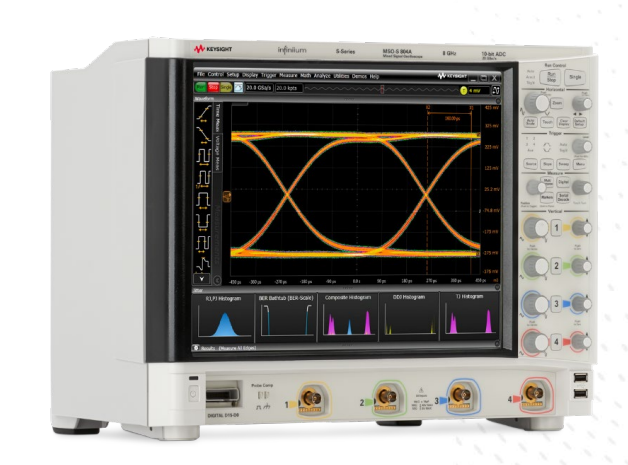
The Keysight Infiniium S-Series covers bandwidths from 500 MHz to 8 GHz with four analog channels. It uses a 10-bit ADC architecture and provides up to 20 GSa/s sample rate, while High Resolution mode can increase vertical resolution to as much as 16 bits. Keysight particularly emphasizes signal integrity, low intrinsic jitter, measurement software, and high-speed digital debugging capabilities.
The Tektronix 6 Series B MSO is available with 4, 6, or 8 FlexChannel inputs, bandwidths from 1 GHz to 10 GHz, and a maximum sample rate of 50 GSa/s when two analog channels are active. Each FlexChannel can operate as one analog input or eight digital inputs when used with the appropriate logic probe.
| Specification | Keysight Infiniium S-Series | Tektronix 6 Series B MSO |
|---|---|---|
| Analog bandwidth | 500 MHz to 8 GHz | 1 GHz to 10 GHz |
| Analog channels | 4 | 4, 6, or 8 |
| Maximum sample rate | Up to 20 GSa/s | Up to 50 GSa/s on 2 channels |
| ADC resolution | 10-bit | 12-bit |
| High-resolution mode | Up to 16 bits | Up to 16 bits |
| Digital channels | 16 on MSO models | Up to 64, depending on configuration |
| Display | 15-inch capacitive touchscreen | 15.6-inch Full HD capacitive touchscreen |
| Main focus | Signal integrity, high-speed digital analysis, jitter and protocol analysis | High channel density, acquisition performance, mixed-domain analysis |
The specifications above are based on current manufacturer documentation. Configurations, optional functions, and performance can vary by model and installed options.
1. Bandwidth and Sample Rate
Bandwidth and sample rate are two of the first specifications engineers consider when selecting an oscilloscope.
The Keysight Infiniium S-Series provides models ranging from 500 MHz to 8 GHz. The platform supports up to 20 GSa/s, enabling engineers to analyze fast transitions, high-speed clocks, serial buses, and other signals requiring high temporal resolution.
The Tektronix 6 Series B MSO extends its bandwidth to 10 GHz. Its acquisition architecture provides up to:
- 50 GSa/s on two analog channels
- 25 GSa/s on four analog channels
- 12.5 GSa/s when more than four analog channels are used
This makes the 6 Series B particularly relevant where engineers need several high-bandwidth analog channels operating simultaneously.
For applications requiring four channels or fewer and bandwidth up to 8 GHz, however, sample rate alone should not determine the choice. Signal integrity, timing accuracy, probe performance, and analysis capability can be equally important.
2. Vertical Resolution and Signal Integrity
ADC resolution is an important factor in an oscilloscope’s ability to distinguish small signal variations, particularly when low-amplitude signals are superimposed on much larger waveforms.
The Tektronix 6 Series B uses a 12-bit ADC, while the Keysight S-Series uses a 10-bit ADC. Both platforms provide enhanced-resolution processing modes capable of reaching up to 16 bits under appropriate acquisition conditions.
However, ADC bit depth is only one component of overall measurement quality.
Keysight designed the S-Series around an integrated signal path consisting of its front end, ADC, timebase, correction filters, and acquisition architecture. According to Keysight, the platform achieves system ENOB values above 8 in certain operating conditions and typical intrinsic jitter of approximately 100 fs, which is particularly relevant for jitter characterization and high-speed serial measurements.
Keysight also specifies approximately 90 µV RMS noise at 1 mV/div and 1 GHz bandwidth for the S-Series.
Tektronix, meanwhile, places particular emphasis on low input noise in the 6 Series B and currently specifies less than 55 µV at 1 mV/div and 1 GHz for the platform.
For engineers evaluating these specifications, it is important to consider the complete test conditions rather than comparing individual noise or ENOB numbers in isolation.
3. Analog and Digital Channel Density
One of the clearest architectural differences between the two platforms is the number of channels.
The Keysight S-Series provides four analog channels, while MSO versions add 16 digital channels for mixed-signal debugging.
The Tektronix 6 Series B is available with four, six, or eight FlexChannel inputs. With compatible logic probes, each FlexChannel can be converted into eight digital inputs, providing configurations with up to 64 digital channels.
This gives the Tektronix architecture an advantage in applications where engineers need to observe a large number of analog and digital signals simultaneously.
By contrast, applications centered around four high-performance analog channels, precision timing measurements, serial-data analysis, or signal-integrity characterization may place greater emphasis on the quality of each measurement channel and available analysis tools.
4. High-Speed Digital Debugging and Analysis
Modern oscilloscopes are no longer limited to displaying voltage over time. For many engineers, the software environment is just as important as the acquisition hardware.
The Keysight Infiniium S-Series provides more than 50 automated measurements, math functions, gating, and spectral viewing as standard capabilities. Additional applications expand the platform to support serial protocol triggering and decoding, jitter analysis, eye diagrams, InfiniiScan, de-embedding, and compliance testing.
This makes the S-Series particularly relevant for applications such as:
- High-speed digital design
- Serial bus debugging
- Signal integrity analysis
- Jitter characterization
- Eye-diagram analysis
- Interface compliance testing
- Embedded system validation
Keysight also states that the platform supports more than 100 compatible probes covering current, voltage, active, passive, 1 MΩ, and 50 Ω measurement requirements.
The Tektronix 6 Series B also provides an extensive set of analysis tools and adds capabilities such as hardware digital downconverters for simultaneous time-domain and frequency-domain analysis. Analog channels can be displayed as time-domain waveforms, spectra, or both.
The difference therefore lies less in whether either platform can perform advanced analysis, and more in the specific workflow, application packages, and measurement ecosystem required by the user.
5. User Interface and Display
Both oscilloscopes use large capacitive touchscreen displays, but the Tektronix platform offers a more recent display architecture.
The Keysight S-Series features a 15-inch XGA capacitive touchscreen with an Infiniium user interface designed for oscilloscope measurement and analysis workflows.
The Tektronix 6 Series B uses a 15.6-inch Full HD display with 1920 × 1080 resolution, together with a multi-touch interface.
The larger resolution of the Tektronix display can be useful when viewing many channels or multiple analysis windows simultaneously.
For Keysight users, however, the Infiniium environment provides close integration between waveforms, measurement applications, protocol analysis, compliance tools, and offline analysis workflows.
6. A Comparison Should Go Beyond Individual Specifications
The original Tektronix comparison highlights advantages of the 6 Series B in ADC resolution, channel count, bandwidth, and sample rate. Tektronix also publishes its own comparative noise and ENOB measurements against the S-Series. These results should be understood as vendor-conducted competitive measurements, with test conditions that may differ from Keysight’s own published specifications.
This is particularly important because specifications such as ADC resolution do not independently determine measurement accuracy.
An oscilloscope’s real-world performance depends on the complete acquisition system, including:
Analog front end → ADC → timebase → acquisition architecture → signal processing → probes → analysis software
For example, Keysight combines its 10-bit ADC with a low-noise front end, correction filters, low-jitter timebase, and high-ENOB acquisition architecture. The S-Series can also achieve up to 16-bit resolution in High Resolution mode.
Therefore, engineers should evaluate the oscilloscope according to the measurements they actually need to perform rather than relying on a single headline specification.
Keysight S-Series or Tektronix 6 Series B: Which Platform Fits Your Application?
Both platforms address demanding high-speed measurement applications, but they approach the problem differently.
The Tektronix 6 Series B MSO provides a strong option when the application requires six or eight analog channels, a large number of digital channels, bandwidth up to 10 GHz, or simultaneous multi-channel spectrum analysis.
The Keysight Infiniium S-Series is particularly suited to applications where engineers require high signal integrity, low intrinsic jitter, high-speed digital debugging, serial protocol analysis, jitter and eye-diagram measurements, de-embedding, and compliance testing within the Infiniium measurement environment. Keysight also provides an extensive ecosystem of software applications and probes for expanding the system according to specific test requirements.
Rather than asking which oscilloscope has the highest individual specification, the more useful question is:
Which oscilloscope provides the measurement performance, analysis functions, probing system, and workflow required for your specific test application?
For many high-speed digital and signal-integrity applications, this system-level approach is essential for obtaining reliable measurement results.